How much do solar panels cost?
A typical domestic solar panel system in the UK costs between £5,500 and £12,500 before adding a battery. Smaller systems for low-use homes sit towards the bottom of that range, while larger systems with more panels, a complex roof or premium equipment cost more.
Add a home battery and the total commonly rises by around £3,000 to £7,000, depending on its usable capacity, brand and whether it is fitted at the same time as the panels.
Those ranges are useful, but they are not a quote. The price for your home depends on how much electricity you use, the amount of suitable roof space you have and how straightforward the installation is. Here is what you are actually paying for, where extra costs appear and how to tell whether a quote is fair.
Solar panel costs at a glance
| Property and usage | Typical system | Panels | Panels only | With battery |
| --- | --- | --- | --- | --- |
| Low use (1-2 beds) | 3-3.5 kWp | 7-8 | £5,500-£7,000 | £8,500-£12,000 |
| Typical use (3 beds) | 4-5 kWp | 9-12 | £7,000-£10,000 | £11,000-£15,000 |
| High use (4+ beds | 6-7 kWp | 14-16 | £10,000-£12,500+ | £14,000-£19,000+ |
These are broad 2026 market ranges for a standard domestic installation. They include the main solar equipment and fitting but assume a roof in reasonable condition and normal access. Your final price may fall outside them.
What is included in the cost of solar panels?
A proper solar quote covers far more than the panels themselves. The visible panels are only one part of the system; the price also pays for the equipment that converts and manages the electricity, the people who install it and the certification needed afterwards.
- Solar panels - the PV modules fitted to the roof. Price varies with output, efficiency, manufacturer and warranty.
- Inverter - converts the direct current generated by the panels into alternating current your home can use.
- Mounting system - rails, brackets, roof hooks and fixings designed for your roof covering.
- Scaffolding and access - normally required for a safe roof installation and sometimes priced separately.
- Electrical work - cabling, isolators, protection equipment, connection to your consumer unit and any necessary upgrades.
- Design and survey - the roof assessment, shading analysis and expected generation calculation.
- MCS certification and DNO work - the paperwork that demonstrates the system meets the relevant standard and notifies or applies to your local network operator.
- Monitoring - the app, meter or online portal used to track generation and spot performance problems.
If one quote looks much cheaper than the rest, check whether scaffolding, certification, roof access and electrical work are included. A low headline price can become less attractive once those items are added later.
How much does each solar system size cost?
Solar installations are normally described in kilowatt peak, written as kWp. This is the maximum rated output of the panels under standard test conditions, not the amount they will generate every hour of the year. The actual output varies because of [how solar panels generate electricity](/articles/how-do-solar-panels-work) under different levels of daylight.
| System size | Approx. panels | Typical installed cost | Usually suits |
| --- | --- | --- | --- |
| 3 kWp | 7 | £5,500-£6,500 | Smaller home or lower electricity use |
| 4 kWp | 9-10 | £6,500-£8,500 | Typical two- or three-bedroom home |
| 5 kWp | 11-12 | £8,000-£10,000 | Three- or four-bedroom home |
| 6 kWp | 14 | £9,500-£12,000 | Larger home, EV or higher use |
| 7 kWp+ | 16+ | £11,000-£14,000+ | Large roof and high electricity demand |
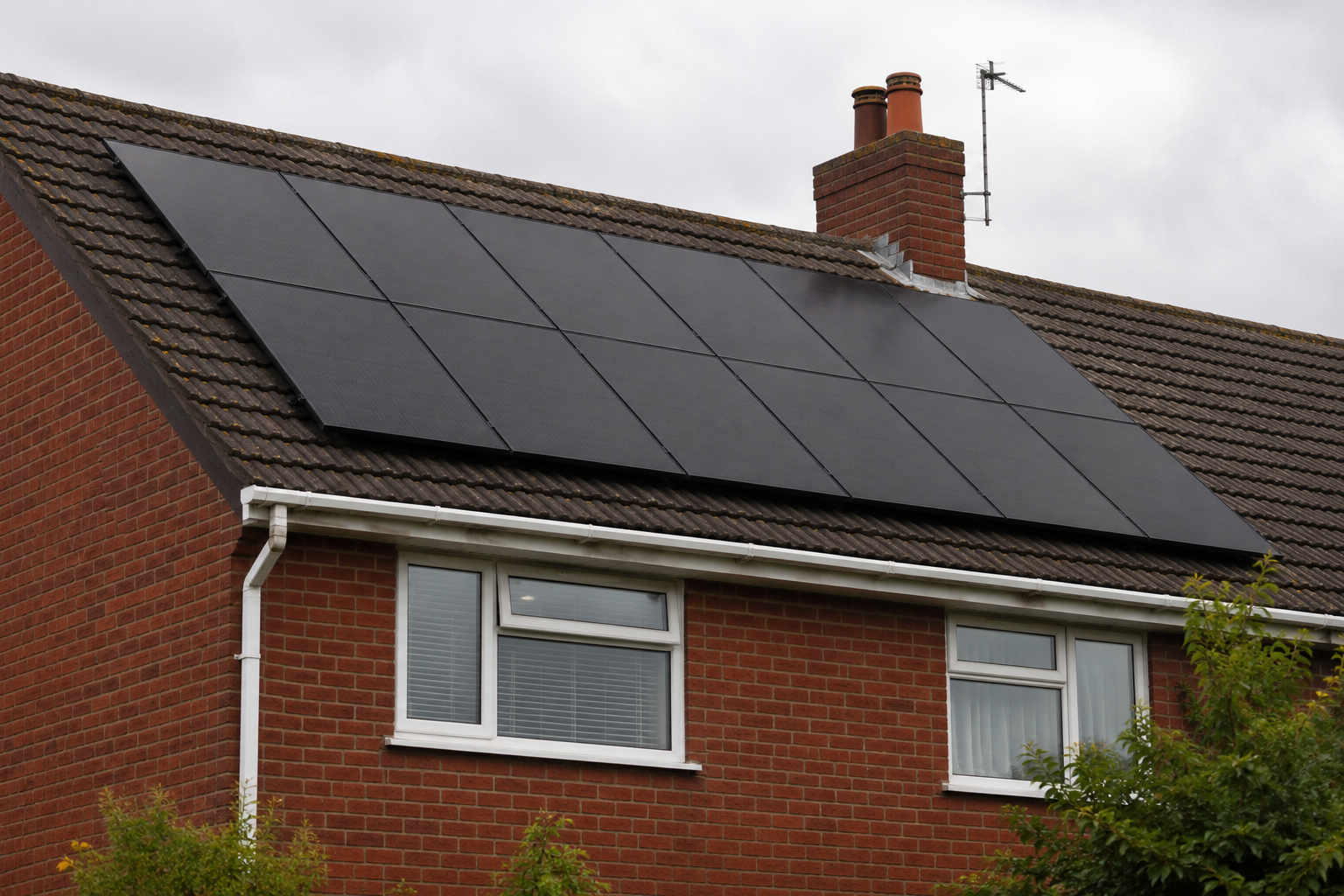
Modern domestic panels are commonly around 400W to 460W each, so the number of panels varies with the exact model. Ten 400W panels create a 4kWp array; nine 450W panels create a slightly larger 4.05kWp array.
The Department for Energy Security and Net Zero publishes official solar PV cost data drawn from the MCS installation database. It reports cost per kW because system size is a more useful comparison than panel count alone. When comparing quotes, divide the total solar-only price by the system's kWp so you can see whether you are comparing like with like.
How much does a solar battery add?
For many homeowners, the battery is the biggest optional cost. A battery stores electricity generated during the day so it can be used later, instead of exporting all the surplus and buying electricity back from the grid in the evening.
| Usable battery capacity | Indicative installed cost | Common use |
| --- | --- | --- |
| <span style="color: rgb(0, 0, 0);">3-5 kWh</span> | <span style="color: rgb(0, 0, 0);">£3,000-£5,000</span> | <span style="color: rgb(0, 0, 0);">Lower evening use or smaller solar system</span> |
| <span style="color: rgb(0, 0, 0);">6-10 kWh</span> | <span style="color: rgb(0, 0, 0);">£4,000-£7,000</span> | <span style="color: rgb(0, 0, 0);">Typical household wanting more evening coverage</span> |
| <span style="color: rgb(0, 0, 0);">10-15 kWh+</span> | <span style="color: rgb(0, 0, 0);">£6,000-£10,000+</span> | <span style="color: rgb(0, 0, 0);">High use, EV, heat pump or backup priorities</span> |
Bigger is not automatically better. An oversized battery may spend much of the winter partly empty, while an undersized one may fill early and export electricity you hoped to save for the evening. The useful comparison is usable capacity, warranty, expected cycle life and how the battery fits your actual usage pattern.
Fitting the battery at the same time as the solar panels can reduce duplicated labour and electrical work. If you may add one later, ask whether the proposed inverter and system design are battery-ready, rather than assuming every system can be expanded cheaply.
What changes the price of a solar installation?
Two homes with the same number of panels can receive noticeably different quotes without either installer necessarily being wrong. These are the factors that create most of the difference.
Your roof and access
A simple two-storey pitched roof is usually cheaper than a flat roof, a three-storey property or a roof split across several orientations. Slate, fragile tiles, dormers, rooflights and limited access can all increase labour or scaffolding costs.
Panel efficiency and warranty
Higher-efficiency panels produce more power from the same roof area and can be worthwhile where space is limited. On a large, unshaded roof, paying substantially more for a small efficiency gain may produce a weaker return. Compare product warranties, performance warranties and the manufacturer's position in the UK, not just the efficiency percentage.
Inverter design
A standard string inverter is normally the lower-cost option. Microinverters or panel-level optimisers can cost more but may be useful where shading or multiple roof directions would otherwise drag down the whole string. A hybrid inverter is designed to work with battery storage, though compatibility still needs checking.
Electrical upgrades
Some homes need work to the consumer unit, earthing or meter position before the system can be connected safely. Larger systems may also require approval from the Distribution Network Operator rather than a simple notification after installation.
Installer support and guarantees
The cheapest quote is not always the cheapest system to own. Workmanship cover, insurance-backed guarantees, monitoring support and a clear process for faults have value after the installers leave. Solar panels may remain on the roof for decades, so aftercare should carry some weight in the comparison.
Are there hidden costs?
There should not be hidden costs in a properly prepared quote, but there are legitimate extras that homeowners sometimes miss. Ask whether the following are included before accepting a price:
- Scaffolding - including extra lifts, conservatory bridging or difficult access.
- Roof repairs - broken tiles, failing felt or structural work should be dealt with before the panels go on.
- Bird protection - mesh around the array may be recommended in areas where pigeons are a problem.
- Consumer-unit work - older electrical installations may need upgrades.
- Export limitation equipment - your DNO may restrict export and require a limiter on some installations.
- Monitoring subscriptions - many platforms are free, but check whether any ongoing service is chargeable.
- Future inverter replacement - the inverter may not last as long as the panels and should be considered in lifetime costs.
- Finance interest - a manageable monthly payment can still create a much higher total repayable amount.
Is VAT charged on solar panels?
Qualifying domestic solar panel and battery installations are currently zero-rated for VAT. The relief applies across the UK and is scheduled to run until 31 March 2027, after which the legislation provides for a 5% rate unless the government changes the rules again.
That does not mean every solar-related purchase automatically receives 0% VAT. The treatment depends on what is supplied and how it is installed, so check the quote rather than subtracting VAT yourself. HMRC's Notice 708/6 sets out the current rules for energy-saving materials.
How much could solar panels save you?
The cost only makes sense alongside the return. [Understanding how long solar panels take to pay for themselves](/articles/solar-panel-payback-period) can help you decide whether the upfront investment represents good value for your home.
Solar saves money in two ways: you avoid buying some electricity from the grid, and you may receive a Smart Export Guarantee payment for surplus electricity sent back.
Self-used electricity is normally worth more than exported electricity. Under Ofgem's price cap for 1 July to 30 September 2026, the average electricity unit rate for a Direct Debit customer is 26.11p per kWh. Export tariffs vary by supplier and may carry eligibility conditions, so the amount you earn for a unit sent to the grid can be very different from the amount you avoid paying by using it at home.
This is why two identical systems can produce different financial returns. A household running appliances, charging an EV or heating water during daylight hours may use more of its generation directly. A mostly empty home without a battery may export a larger share.
The Energy Saving Trust's solar calculator estimates cost, system size and savings using property and energy-use information. It also warns that export limits, high-demand appliances and tariff choices can change the result. Treat any online estimate as a sensible starting point, then ask the installer to show the assumptions behind their forecast.
How to compare solar panel quotes properly
Get several quotes, but do not compare only the final totals. Put the following details next to each other:
- System size in kWp - not simply the number of panels.
- Expected annual generation - with roof direction, shading and location stated.
- Exact panel and inverter models - including product and performance warranties.
- Battery usable capacity - rather than the larger headline or nominal capacity.
- Total price and exclusions - including scaffolding, VAT, DNO work and certification.
- Savings assumptions - especially the electricity price, export tariff and percentage used at home.
- Workmanship and aftercare - including who handles faults and what happens if equipment fails.
Be cautious if an installer will not identify the proposed equipment, promises an unrealistic bill reduction without asking about your usage or uses a same-day discount to prevent comparison. A reputable quote should still make sense after you have had time to read it.
Can you get solar panels for free?
There is no universal grant giving every UK homeowner free solar panels. Some households may qualify for fully funded or subsidised improvements through income-, benefit-, location- or EPC-based schemes, including local delivery of wider home-energy programmes. Eligibility and availability vary, and funding can change.
For homeowners who do not qualify, the main nationwide financial benefits are the current 0% VAT treatment and the ability to receive export payments through the Smart Export Guarantee. Be wary of adverts that present finance, leases or eligibility checks as a guaranteed government grant.
So, how much should you budget?
For a typical UK home, a sensible starting budget is around £7,000 to £10,000 for the solar installation alone, or roughly £11,000 to £15,000 when a suitably sized battery is added. Smaller straightforward systems can cost less; larger or more complex installations can cost considerably more.
The question is not whether your quote matches one national average exactly, but [are solar panels worth it?](/articles/are-solar-panels-worth-it) That depends on whether the system is correctly sized, the price is transparent and the projected savings reflect your roof and electricity use.
You can start with the Go Solar Today savings calculator to get an indicative figure using your home, roof direction, electricity bill and battery preference. If the numbers look sensible, get a free quote and we will match you with up to four vetted, MCS-certified installers covering your postcode, so you can compare real prices rather than relying on a broad online range.
Frequently asked questions
How much do solar panels cost for a three-bedroom house?
A three-bedroom home will commonly need a system around 4kWp to 5kWp, costing roughly £7,000 to £10,000 without a battery. With battery storage, a broad starting range is around £11,000 to £15,000. Electricity use and roof space matter more than bedroom count alone.
How much does a 4kW solar system cost in the UK?
A straightforward 4kWp domestic installation commonly costs around £6,500 to £8,500. Premium equipment, complex scaffolding, multiple roof faces or electrical upgrades can push the price higher.
How many solar panels does the average house need?
Many typical homes use around 9 to 12 modern panels, creating a system of roughly 4kWp to 5kWp. The correct number depends on the wattage of each panel, annual electricity use, roof dimensions, orientation and shading.
Is it cheaper to install solar panels and a battery together?
It can be. Installing both at once may avoid duplicated labour, electrical work and call-out costs. If you install solar first, ask for a battery-ready design and confirm future compatibility in writing.
Will solar panels remove my electricity bill completely?
Usually not. Solar output changes by season and stops at night, and most grid-connected homes continue paying a standing charge. A well-designed system can reduce imported electricity substantially, but claims of a guaranteed zero bill should be treated carefully.
What is the cheapest way to buy solar panels?
Paying cash avoids finance interest, but only if it leaves your finances comfortable. Finance can spread the cost, although the total repayable amount may be much higher. Compare the cash price, deposit, interest rate, term and total repayable before deciding.
---
Sources
- Department for Energy Security and Net Zero, Solar photovoltaic (PV) cost data, updated 28 May 2026: <https://www.gov.uk/government/statistics/solar-pv-cost-data>
- Energy Saving Trust, Solar panel calculator, updated 20 May 2026: <https://energysavingtrust.org.uk/tool/solar-energy-calculator/>
- Ofgem, Energy price cap unit rates and standing charges, 1 July to 30 September 2026: <https://www.ofgem.gov.uk/information-consumers/energy-advice-households/energy-price-cap-unit-rates-and-standing-charges>
- GOV.UK, Smart Export Guarantee guidance: <https://www.gov.uk/government/publications/smart-export-guarantee-seg-earn-money-for-exporting-the-renewable-electricity-you-have-generated>
- HMRC, VAT Notice 708/6 - Energy-saving materials and heating equipment: <https://www.gov.uk/guidance/vat-on-energy-saving-materials-and-heating-equipment-notice-7086>